
Water Treatment Plant Services
Our Service
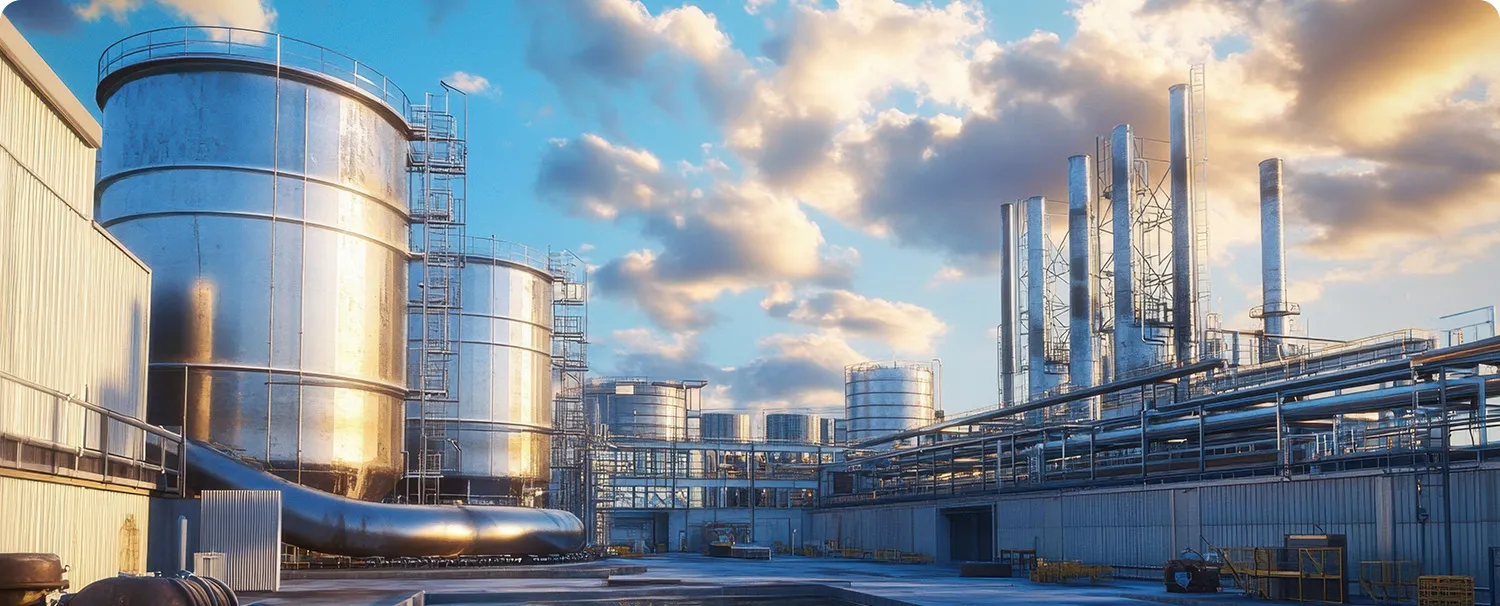
We provide total support for wastewater treatment— from plant design and manufacturing to installation and after-sales service.
- Compact design
with no large site required - Fully automated
—no specialists needed - Simple system
easy to maintain - Low running cost
with less environmental impact
We prioritize these core concepts while remaining flexible to our clients' specific needs. If your existing system is experiencing issues, we offer expert consultation to improve or modify it for optimal performance. Following installation, we conduct thorough performance checks and provide post-delivery maintenance to ensure your system operates reliably and with maximum efficiency.
Below we introduce our three representative water treatment facilities:
1. BIO ALSi Microbial Treatment Plant
The ultimate microbial treatment system
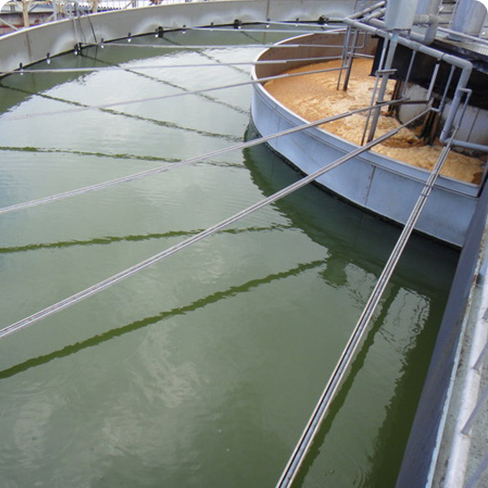
Ability to break down diverse organic substances
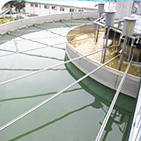
Using aerobic and anaerobic microorganisms, it can break down various difficult‑to‑decompose organic substances.
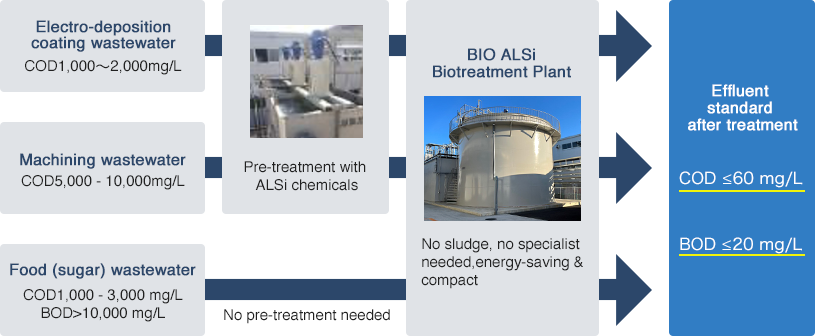
Examples of compatible wastewater
Food manufacturing wastewater, machining wastewater, water‑soluble cutting oil, release agents for die‑cast molds, automotive paint wastewater, cosmetics manufacturing wastewater, etc.
Minimal excess sludge generation
Our advanced microbial process minimizes the generation of excess sludge compared to conventional activated sludge methods. This significantly lowers dewatering requirements and long-term waste disposal costs.
Compact and simple design for easy maintenance
Its simple design saves space and makes maintenance easy. Equipment is kept to a minimum (requiring only mixers, blowers, and pumps).
Comparison between BIO ALSi and conventional processes
| Operation | Sludge | Chemicals | Waste | |
|---|---|---|---|---|
| BIOALSi | Automatic | None generated | Not used | Small amount |
| Other processes | Manual | Large amount | High consumption | Large amount |
BIOALSi
Other processes
The BIO ALSi process can operate automatically and unattended, does not generate sludge, does not use chemicals, and produces only a small amount of waste (a 1:5 ratio). By contrast, other physico-chemical processes require manual operation, produce large amounts of sludge and consume chemicals, and generate significant waste.
Examples and cost comparison
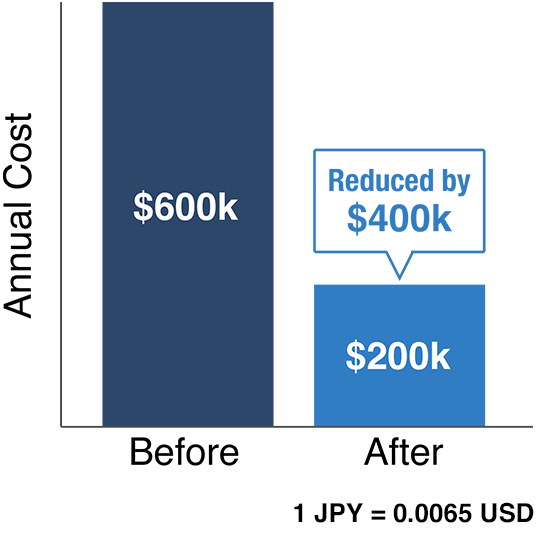
Ex.1 Waste liquid from water-soluble cutting oil (Automobile Manufacturing)
- Before implementation:
- Annual cost of 60 million yen for in-house incineration ($600k).
- After implementation:
- Processing with BIO ALSi reduced costs to 20 million yen ($200k), one-third of the pre-implementation cost
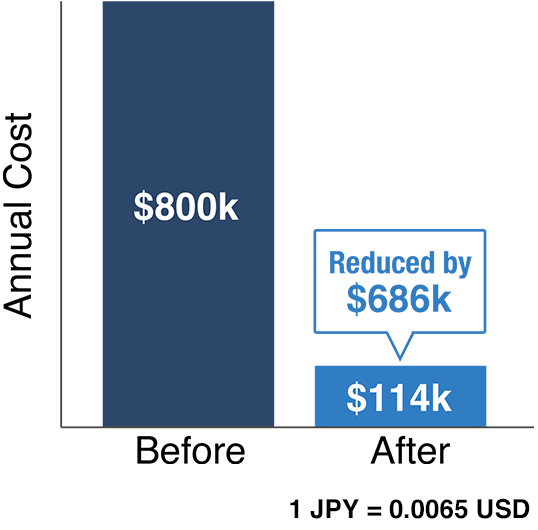
Ex.2 Release agent waste (Automobile Manufacturing)
- Before implementation:
- 4,800 tons of sludge generated annually with a disposal cost of 80 million yen per year ($800k).
- After implementation:
- Sludge volume reduced to 1/100 and disposal costs reduced to 1/7, lowering sludge disposal cost to 11.42 million yen ($114k).
Treatment Flow
Installation Example
-
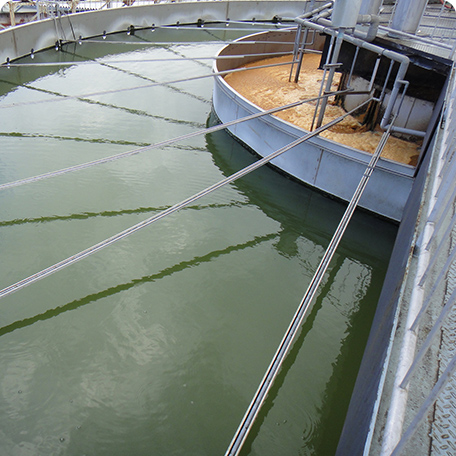
Frozen food company
Diameter: 16 m, height: 6.5 m
Wastewater volume: 1,500 m³/day (frozen food manufacturing wastewater)Influent Treated water BOD 2,000mg/L 20 mg/L or less SS (Suspended solids) 200mg/L 50 mg/L or less n-Hex (oil) 150mg/L 1 mg/L or less -
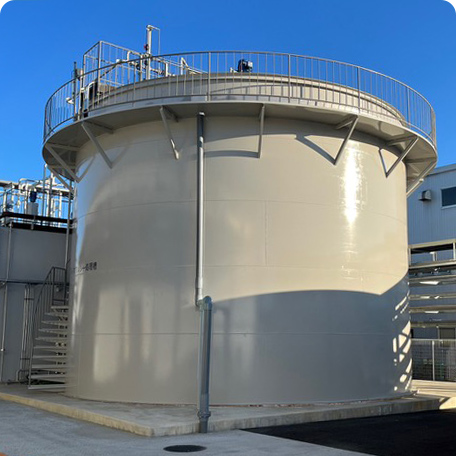
Beverage manufacturing company
Diameter: 10 m, height: 6.5 m
Wastewater volume: 400 m³/dayInfluent Treated water BOD 900mg/L 20 mg/L or less COD 600mg/L 20 mg/L or less SS (Suspended solids) 250mg/L 70 mg/L or less n-Hex (oil) 100mg/L 10 mg/L or less -
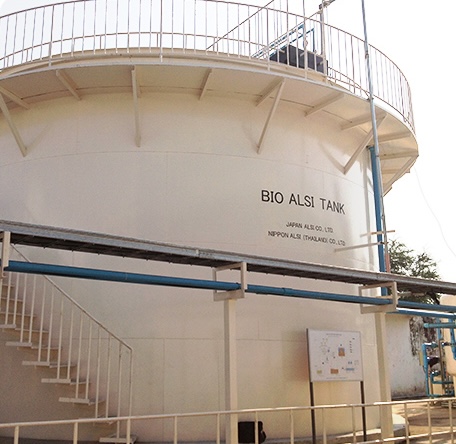
Automobile company
Diameter: 10 m, height: 6.5 m
Wastewater volume: 300 m³/day (paint wastewater)Influent Treated water BOD 700mg/L 20 mg/L or less COD 2,000mg/L 50 mg/L or less SS (Suspended solids) 100mg/L 10 mg/L or less n-Hex (oil) 100mg/L 5 mg/L or less -
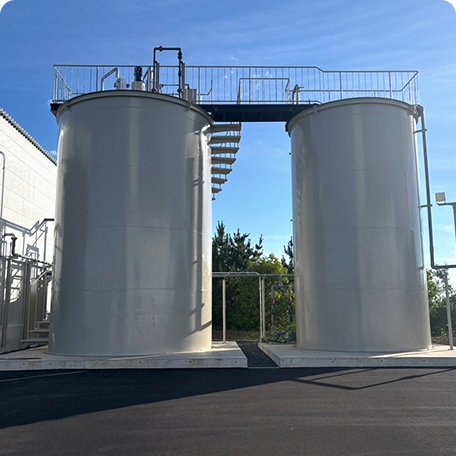
Cosmetics manufacturing company
Diameter: 4 m, height: 6 m
Wastewater volume: 40 m³/day (cosmetics manufacturing wastewater)Influent Treated water BOD 800mg/L 20 mg/L or less SS (Suspended solids) 500mg/L 50 mg/L or less n-Hex (oil) 300mg/L 5 mg/L or less
2. Screw Press Dehydrator
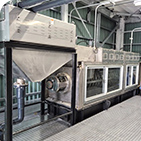
A high-efficiency dewatering machine for continuous, automatic operation.
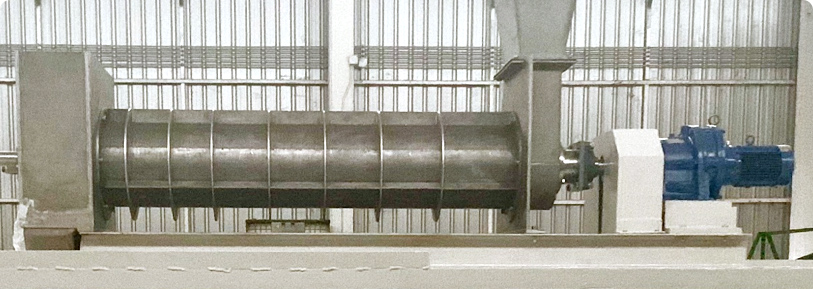
Features and mechanism
- Features:
- High dewatering efficiency; requires minimal wash water; low noise; high durability; reduces maintenance costs; allows continuous automatic operation.
- Mechanism:
- Utilizing a tapered screw, the system compresses sludge to extract moisture (filtrate) through a precision-perforated metal filter as shown on the diagram below.
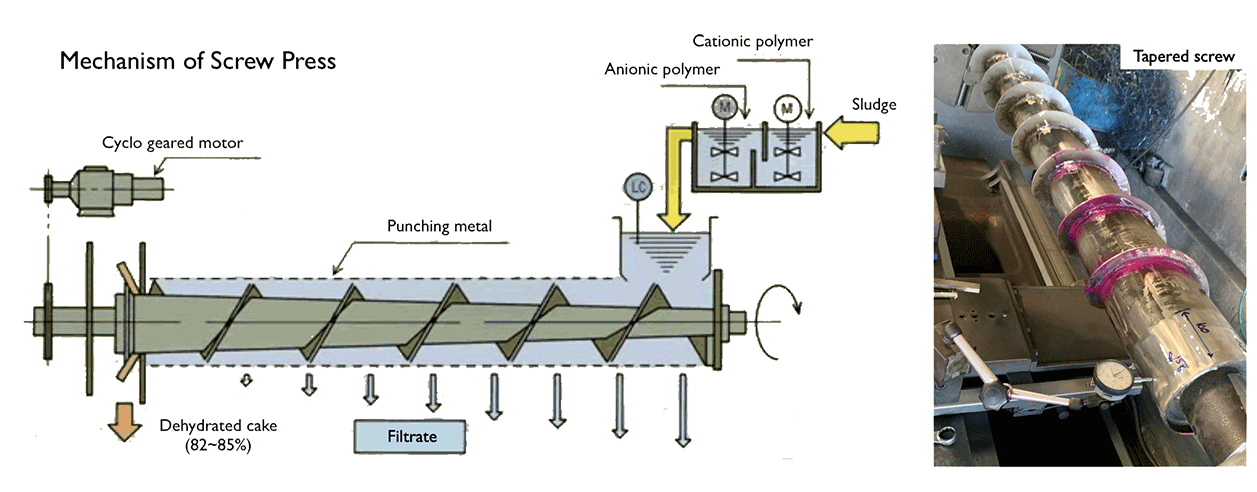
Compressed sludge is discharged as a "dewatered cake" with a typical moisture content of 82–85%.
Example installation flow
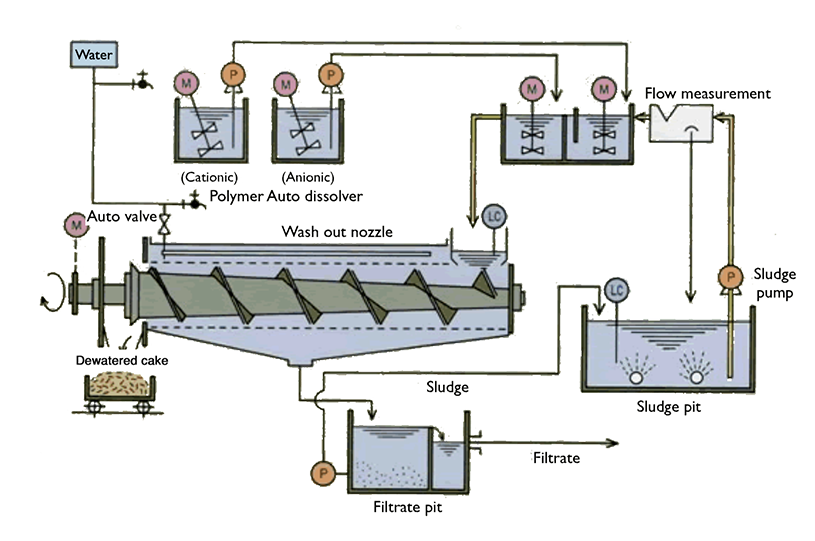
The diagram below illustrates the overall flow of the screw press dewatering system. The system consists of several key components:
- Automatic polymer dissolving unit (cationic and anionic polymer)
- Sludge pump (feeds sludge to the screw press)
- Wash out nozzles and automatic valves
- Filtrate pit (separates and collects liquid)
- Dewatered cake (solid part remaining after compressing sludge)
Applications
- Dewatering of excess activated sludge
- Mainly used in food factories, automobile and machinery plants, industrial estates and sewage treatment plants.
- Dewatering of floating scum from dissolved air flotation units
- Used in seafood processing plants and automobile and machinery plants.
- Waste treatment
- Mainly used at sewage treatment plants
3. Dissolved Air Flotation Unit (DAF)
Maximized Efficiency through Continuous Automation
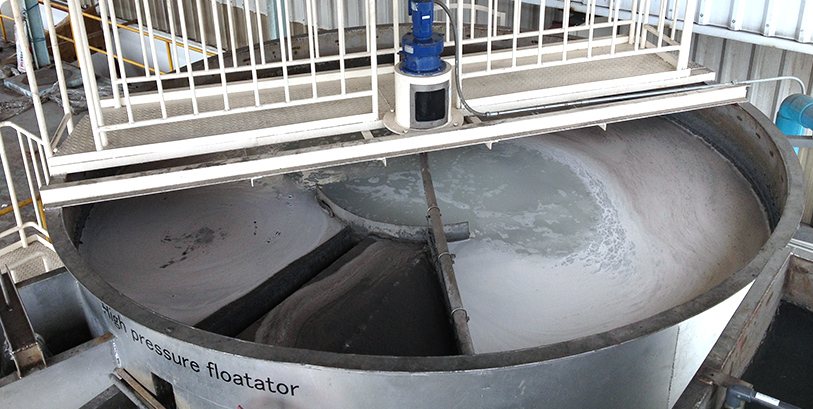
Features
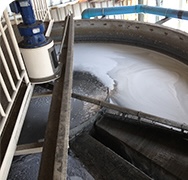
Our DAF units provide a significantly more compact footprint than conventional settling tanks, due to their higher surface loading rate. While settling tanks rely on heavy flocculants for sedimentation, DAF uses microscopic bubbles to lift solids. This makes the system ideal for removing light oils and fine particles.
*Using our proprietary flocculant “ALSi Floc N100 series” produces flocs lighter than those generated by conventional inorganic flocculants.*
| Settling tank | Dissolved air flotation unit | |
|---|---|---|
| Separation method | Separates solids by settling | Separates solids by flotation |
| Amount of flocculant used (if used) |
Requires large amounts of inorganic flocculants to increase specific gravity | Small amount of flocculant suffices |
| Required space | Requires large space | More compact compared with settling tanks |
| Power consumption | Low | Slightly higher than settling tanks |
| Suitable wastewater | Wastewater containing heavy solids | Wastewater containing light solids |
Mechanism
- A portion of the wastewater is pressurized and saturated with dissolved air.
- The pressurized water is mixed with the raw wastewater as it enters the flotation tank.
- A rapid drop in pressure causes the dissolved air to release, forming a dense cloud of microscopic bubbles.
- These tiny bubbles attach to suspended solids, creating "flocs" that rise to the surface.
- The floating flocs are then continuously removed from the surface by a scum scraper (scum collection devices)
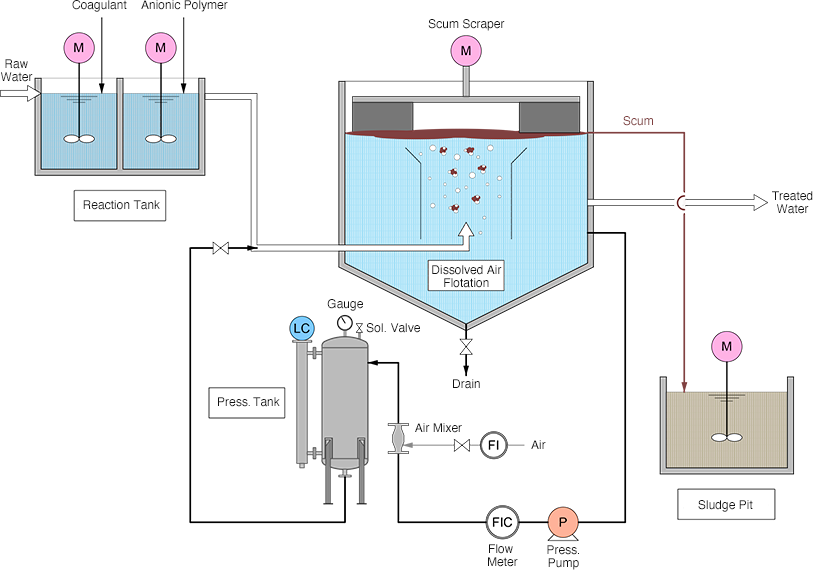
Example installation flow
The diagram below shows the overall flow of the dissolved air flotation unit system.
Key components include:
- Reaction tank (injects coagulant and flocculant (anionic polymer) to coagulate the raw water)
- Pressure tank (dissolves air in the pressurized water and promotes flotation separation)
- Dissolved air flotation tank (uses fine bubbles to separate flotation scum)
- Scum collection device (scrapes and processes the floating scum)
- Sludge pit (temporarily stores sludge that has settled at the bottom of the flotation tank)
- Treated water outlet (discharges the clarified water after separation)
Applications
- Oil removal
- Used in automobile and machinery plants, cosmetics factories, food factories, etc.
- Separation of solids (flocs) after coagulation
- Used in automobile and machinery plants, cosmetics factories, food factories, etc.
- Pretreatment for biological treatment (removal of suspended solids and oils)
- Mainly used in food factories
Download catalogue
Our water treatment equipment catalogue is available for download. Please refer to it for further details.
DownloadIf you have any concerns regarding wastewater treatment, please consult with us here.
Contact usCompany Profile
Download our Company Profile to learn more about our solutions